Host Awareness
Write this so someone with no background can follow.
The problem in one sentence
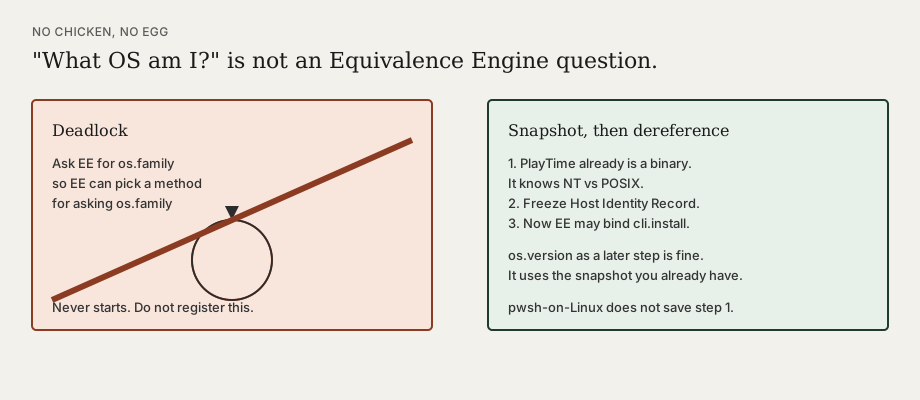
PlayTime must know "what computer is this?" before it asks the Equivalence Engine for commands. If it asked the engine in order to learn the OS, that would be a loop that never starts.
So: learn the host first (this page). Then bind intents (the engine).
Host Identity Record
Every probe must fill this record. Call the framework Host Awareness. Call this struct the Host Identity Record.
| Field | Meaning |
|---|---|
|
Kernel class: |
|
Product name: |
|
Cousins (Linux |
|
OS version string |
|
|
|
Extra hats, not a new family: |
|
Shells on PATH: |
|
Package managers on PATH: |
|
Formats this host can run: |
Filesystem rules already use family and inherits (see equivalence-rules-filesystem context.sdl). Host Awareness must stay aligned with that.
macos in the CLI catalog and darwin as a kernel class are the same family for matching.
Probe kinds (baked into PlayTime)
A probe kind is a tiny built-in action. A table cannot invent a new kernel API. These kinds ship inside PlayTime:
| Kind | What it does |
|---|---|
|
Use the D compiler’s |
|
POSIX |
|
Read |
|
Windows |
|
Is this program on PATH? (Do not shell out to |
|
Escape hatch: run a command. Use only for an OS we barely know. |
Prefer file and API probes. Do not build Windows/Linux/macOS detection out of shell one-liners.
Probe table (data, then baked)
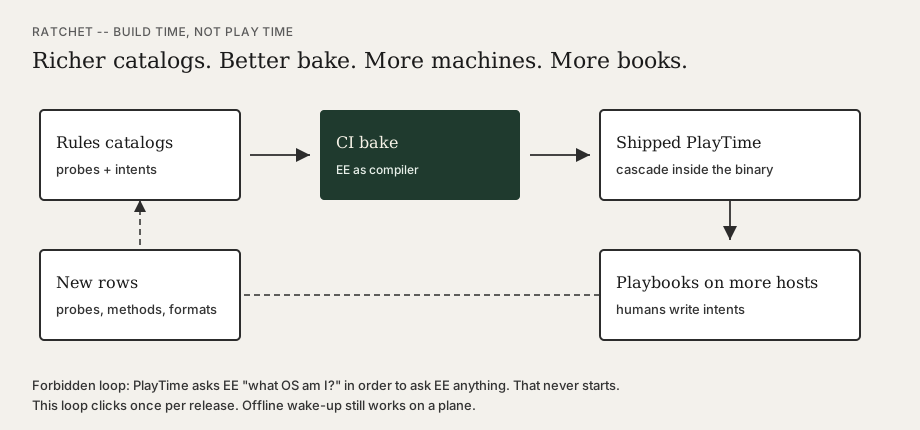
The ordered list of probes lives as shared data (SDL/JSON next to host rules). CI runs the Equivalence Engine as a compiler and writes a cascade into PlayTime (for example lib/embed/probes.generated.json). Pin the rules git revision.
The first cascade may be hand-written (compiler stage 0). After that, the engine generates it. Humans review the diff.
PlayTime at run time must not call the Equivalence Engine to learn family. It only walks the baked cascade.
What we will not do
-
Wait for every OS vendor to give us a
get_os()call. -
Register
os.familyas an intent used to start a run. -
Treat every Linux distro as a PlayTime code change (
os-releaseandID_LIKEalready exist). -
Ship a PlayTime that cannot detect Windows, Linux, or macOS without downloading rules.
A new Unix-like distro that speaks os-release is data only (next bake). A kernel that is neither NT nor POSIX needs a new probe kind in PlayTime, then a table row.
Growth loop
Catalogs get richer → CI bakes a better cascade → PlayTime wakes up on more machines → people write more playbooks → they register more intents and probes → the next bake is richer. Each release is a ratchet.
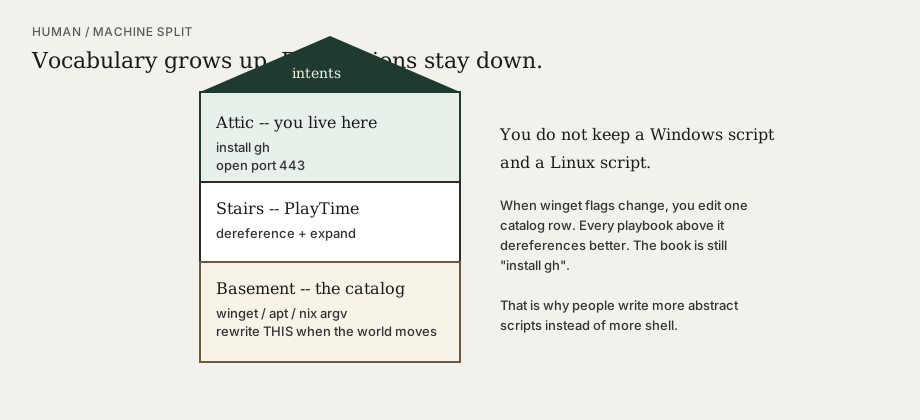
Humans stay at the intent layer. When the world changes, they redefine the bottom catalog, not the playbook.
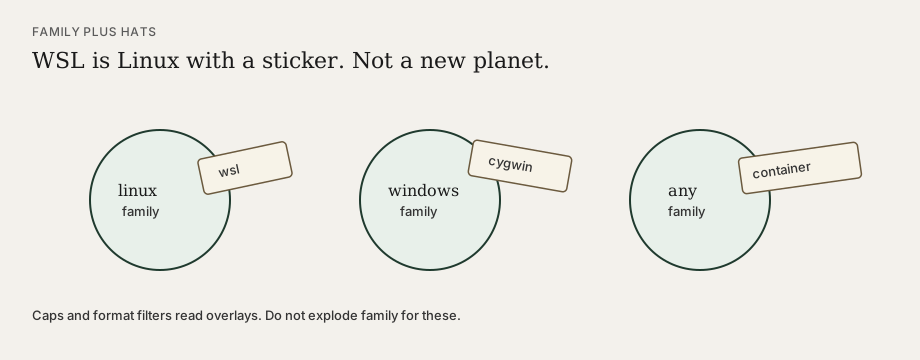
Overlays (wsl, cygwin, container) are stickers on a family, not new planets.