Git’s file-shaped change model
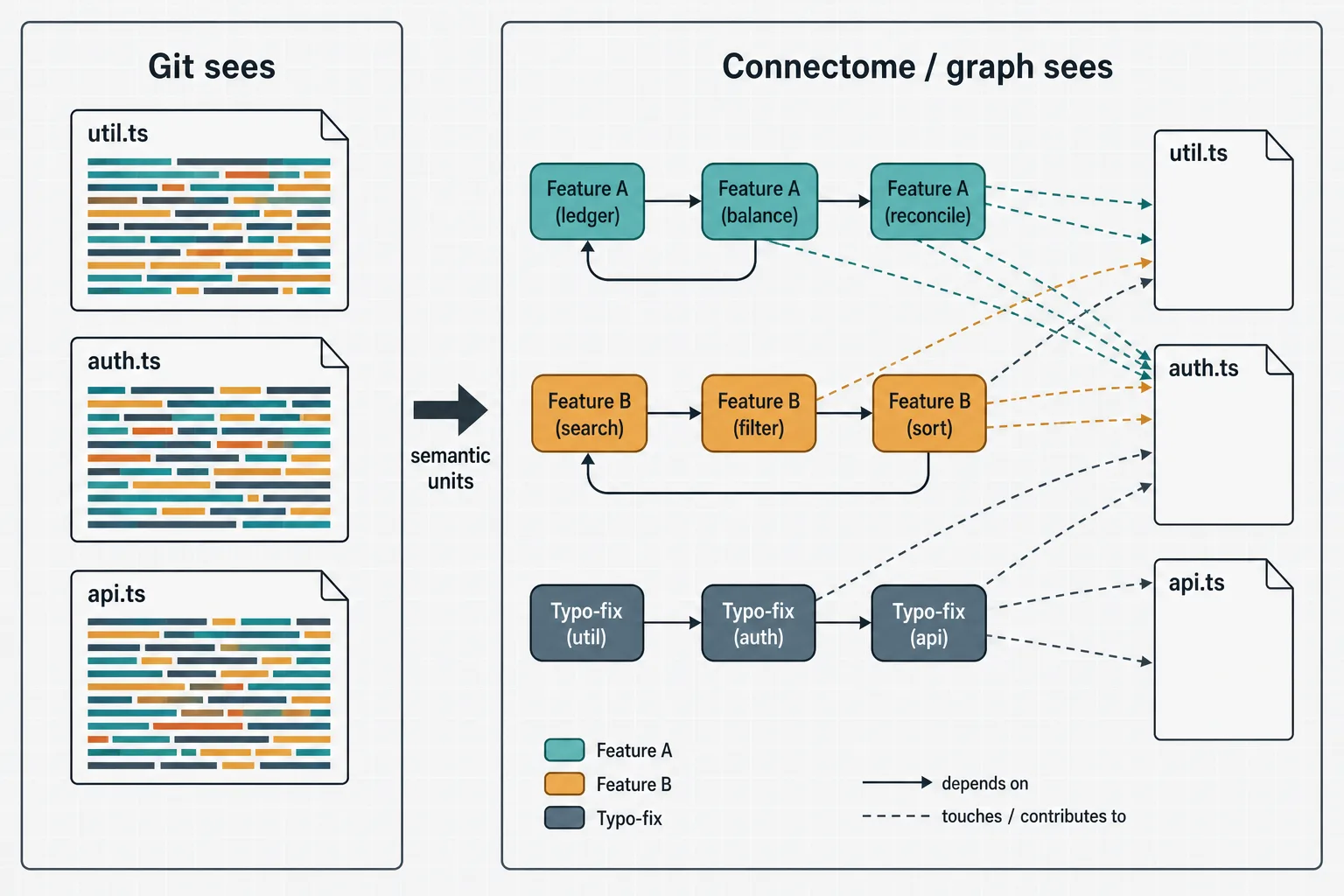
Git feels difficult for many teams for a structural reason: it does not model features or dependencies. It models files (blobs in trees) and commits over those trees. Everything that makes collaborative coding pleasant—orthogonal functions in one module, API edges across modules, “just take Alice’s typo fix”—is metadata Git never stored.
This is the Dev-Centr practitioner framing. Canonical connectome design for the same thesis: connectome-fs: Semantic change units.
The file is the wrong primary key
Intra-file unrelated work
Developers routinely park independent changes in one path: a bugfix beside a feature, a rename beside a refactor. Git can stage hunks, but hunks are not durable identities. History, code review, and bisect still speak in paths and line ranges. You cannot ask the object store for “feature B” as a first-class unit that happened to share a file with “feature A.”
Inter-file dependencies
Compilers, bundlers, and LSPs maintain dependency graphs. Git merge does not. When two people edit opposite ends of a call chain, the VCS has no edge that says the changes are coupled—or that they are not. Conflict detection collapses to “did the same lines move,” which both over-reports (unrelated functions in one file) and under-reports (semantic break across files with a clean text merge).
The stash / pull / pop tax
A common team failure mode:
-
Person A lands a tiny fix (typo, import sort, comment) on
main. -
Person B was editing an unrelated function in the same file.
-
B stashes, pulls, unstashes—and now negotiates a diff for a system they were not touching.
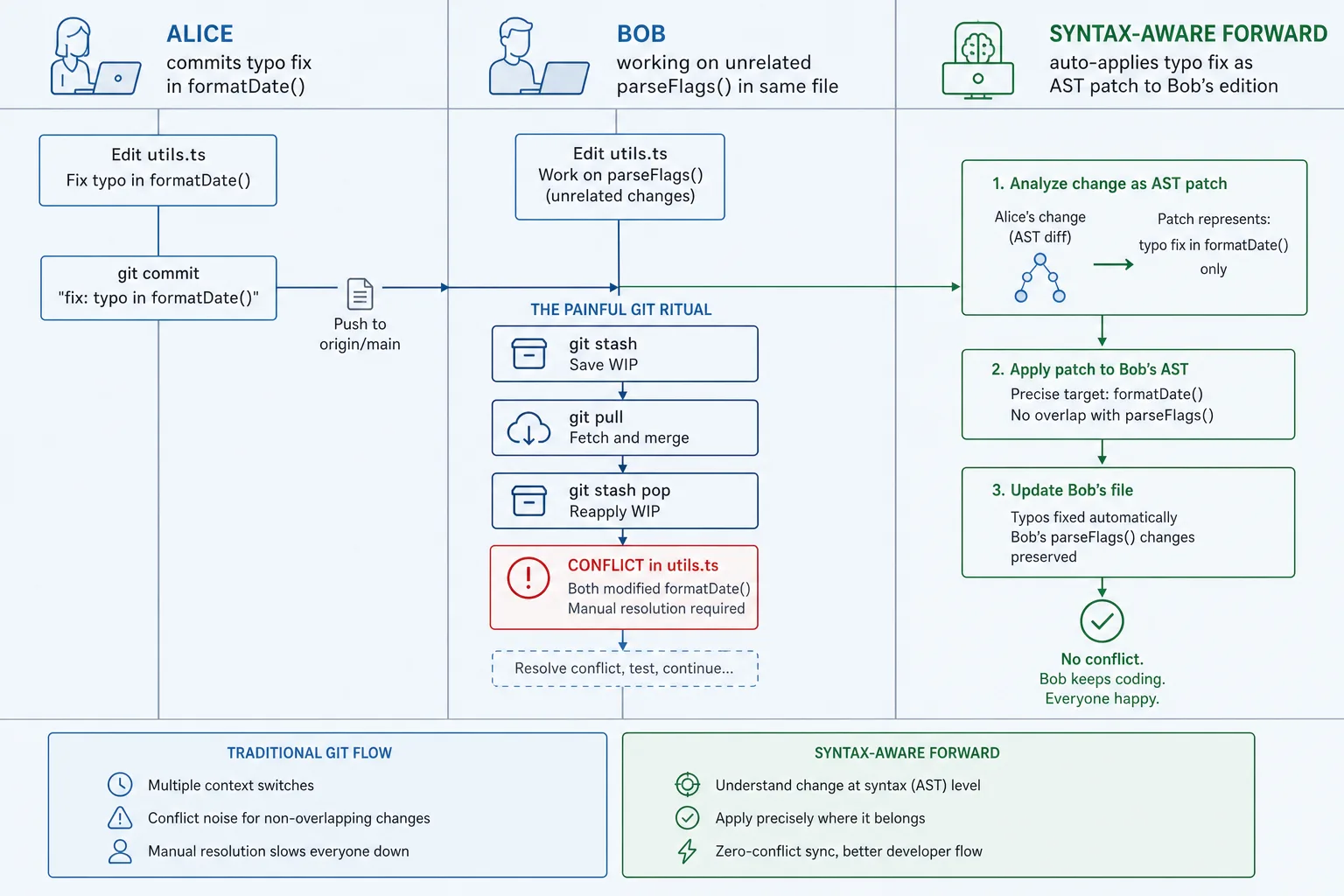
The pain is not that B refuses to integrate. The pain is that file identity forced a dependency that did not exist in the problem domain.
Adjacent attempts
-
Patch modes and virtual branches (e.g. GitButler) — better hunk bookkeeping in one working tree; still path-shaped under the hood.
-
Jujutsu-style operation logs — healthier uncommitted graph; still blob-centric unless a semantic layer is added.
-
Unison — content-addressed definitions; renames and refactors are graph ops. Strong proof that code identity should not be “path + line.”
-
connectome-fs — GUID nodes, typed associations (
depends-on, …), and editions so the filesystem itself can carry the meta-model Unison demonstrates for one language.
Syntax-aware auto-forward
The desirable end state for provably boring edits (identifier typo in one definition, pure formatting inside an AST node):
-
Attach the patch to a stable semantic id
-
Forward it into peer editions / in-flight work that share that id
-
Skip the conflict UI when interference analysis says the peer never touched that unit
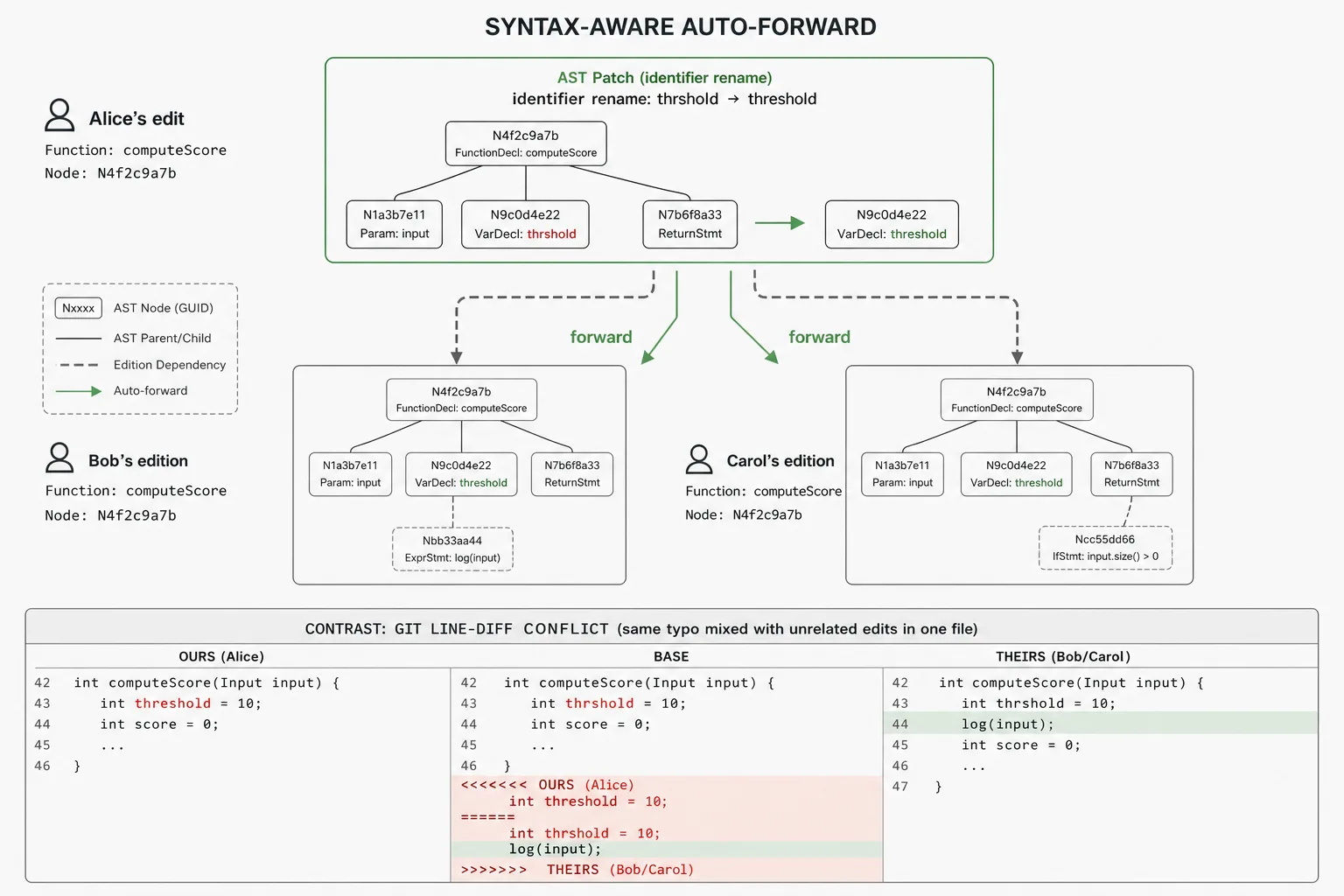
Behavioral changes stay in review. Broadcast hygiene should not require a merge ceremony.
How this fits the concurrency essays
Git concurrency enshittification asks why many live states are hard (worktrees, virtual branches, Phase A bridges → filesystem editions).
This page asks why one live state is still hard when the unit of change is wrong. You need both:
-
Editions (or a Phase A bridge) so agents and humans do not thrash one working tree
-
Semantic units so merges and sync respect features and dependencies, not only paths
Stub for “what remains of Git after editions”: VCS over FS editions.