Secrets distribution hub
Vendors create credentials. Humans (and agents) should not re-enter those credentials every time a preview host, team scope, or deploy matrix changes.
Name the credential by architecture before you distribute it: API key vs token (long-lived project keys and PATs are still keys; short-lived handshake credentials are access tokens).
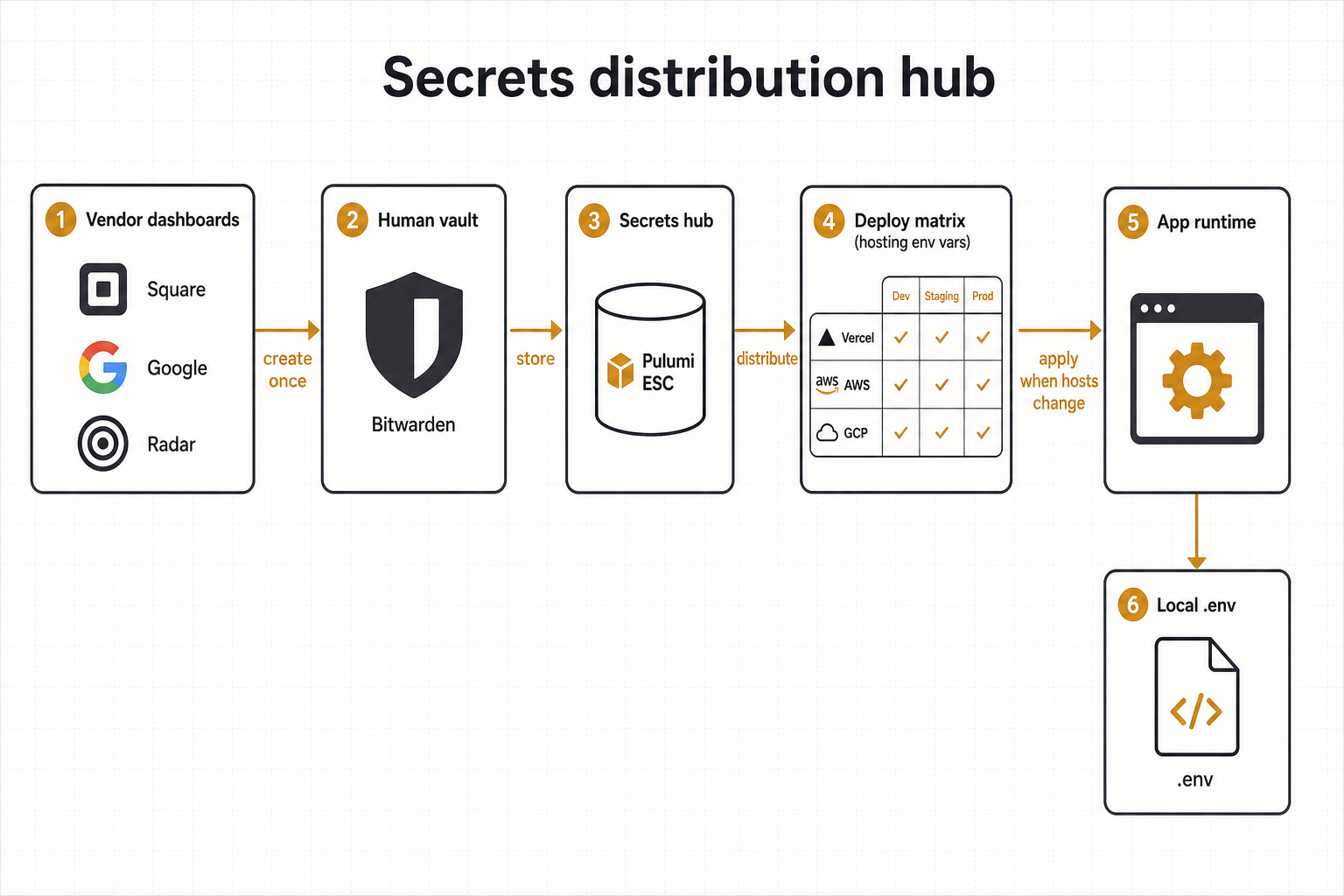
The split that matters
-
Create — each vendor dashboard (OAuth client, deploy key, publishable key).
-
Store — human vault (Bitwarden, 1Password, …) with custom fields for machine-readable API material; optionally a deploy-time hub (Pulumi ESC, cloud secret manager). For Bitwarden server choice (cloud vs official self-host vs Vaultwarden), see Bitwarden and Vaultwarden.
-
Distribute — local ignored env files; hosting project env (Vercel, Netlify, …); CI secrets.
The hosting UI is a target, not the long-term source of truth.
Where agents fit
Agents coordinate CLIs and MCP:
-
Vault CLI — unlock, search, read custom fields (prefer over pasting secrets into chat).
-
Hosting CLI —
env ls/env addagainst the correct org/team project. -
MCP — optional when a server is authenticated and exposes the right tools. A linked hosting MCP is convenience; a vault MCP that only manages org groups is not a substitute for the vault CLI.
-
Package managers — install CLIs with the team’s preferred global tool (
pnpm add -g,winget, …). Package catalogs do not always ship every CLI.
See also Composio and MCP connectors and Studio MCP install strategies.
Pulumi ESC (and friends)
Infrastructure as Code can own distribution:
flowchart LR
  V[Vendor consoles] -->|create once| H[Human vault]
  H -->|seed| E[Secrets hub ESC]
  E -->|sync / apply| M[Hosting env matrix]
  E -->|optional| L[Local pull / run]
  M --> R[App runtime]
Changing BETTER_AUTH_URL / public app URL / which Vercel project receives keys should be a hub + apply step—not a scavenger hunt through browser password managers.
App data schemas (for example Convex schema.ts) still live with the application. Org infra repos often start as DNS/email only; promote app secrets into ESC when the matrix pain shows up.
Ownership patterns
-
Org email logins for SaaS that allows it (Radar, Customer.io, Google Cloud OAuth clients).
-
Personal identity + Business app when the vendor forces one-human-one-login (common for Meta/Facebook): keep one personal account, create a Business/Developer app, invite the org email as admin, store Client ID/Secret under the org vault item.
-
Generated locals (
BETTER_AUTH_SECRET, token encryption keys)—create per environment; do not reuse local secrets in production.