Open-source ecosystems: failures, successes, and why Dev-Centr is not “perfectly OSS”
Dev-Centr’s flagship license is source-available, not OSI “Open Source.” That is intentional. This page is the discourse and history book behind that choice: repeated industry patterns where a commons grows, wealth concentrates elsewhere, and the parent ecosystem is left underfunded, captured, or torn apart by governance fights.
It does not replace legal texts. Pair it with Licensing (CSL / ANL).
The pattern we keep seeing
A project becomes load-bearing. Companies build billion-dollar products on top. Then one or more of these happen:
-
Extraction without return — use the code, brand gravity, and update pipes; contribute little maintenance, little cash, little people-time.
-
Capture — one company becomes the de-facto steward of “the project,” trademark, plugin directory, or release narrative.
-
License whiplash — permissive license → cloud providers productize it → maintainers relicense → community forks → years of trust debt (Redis / Elastic / MongoDB loop).
-
Maintainer burnout — critical infrastructure rests on one volunteer or a tiny unpaid core (the comic everyone already knows).
Dev-Centr’s CSL ladder (branding / competing use / incorporation limits) is an attempt to price some of those failure modes in at the license layer, instead of discovering them after market power exists and the only remaining tools are scorched-earth blogs and courtroom theater.
Comic: the whole industry on one unpaid maintainer
xkcd 2347 — Dependencyunchecked is the meme that stuck because it was already true.
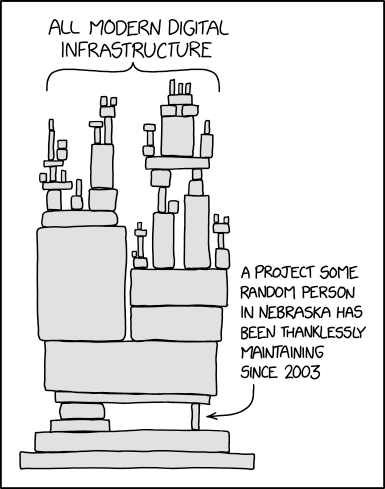 unchecked
- License note
-
xkcd comics are CC BY-NC 2.5unchecked. Keep attribution when reuse goes beyond linking.
Real cases that match the comic
| Case | Why it belongs in the history book |
|---|---|
OpenSSL / Heartbleed (2014) |
A cryptography library under almost the entire web was maintained by a tiny team on scraps of funding. Heartbleed forced the industry to admit the comic was literal. The Linux Foundation’s Core Infrastructure Initiative was a direct response—corporate money arriving after the crisis. |
left-pad (2016) |
An 11-line npm package vanished when its author unpublished packages after a naming dispute. Build pipelines across the industry broke. Dependency depth + micro-packages + single-maintainer publish rights = systemic risk. |
xz-utils / liblzma (2024) |
Not “underfunded volunteer,” but the same fragile surface: a critical compression library with a thin maintainer graph became a social-engineering target. Trust in “tiny crucial deps” works both ways—burnout and capture. |
curl and other “quiet” critical tools |
Daniel Stenberg and peers have spent years explaining that industry-scale reliance does not automatically fund the people who answer security mail. The comic is a lifestyle for many C library maintainers. |
Failure study: WordPress governance vs parasitic extraction (2024–2026)
- Primary watch (mandatory for this discourse)
-
WordPress Is Eating Itself Alive (Coding with Lewis, ~35 min).
| Field | Value |
|---|---|
YouTube |
|
Drive backup |
Google Drive copyunchecked ( |
Decentralized host |
No PeerTube / Odysee / LBRY mirror of this upload found as of 2026-09-02. Prefer those hosts when a durable copy appears — see Decentralized video platforms. Related Odysee discussion of the same conflict exists (different creators), e.g. Destination Linuxunchecked and Brodie Robertsonunchecked. |
- Blurb
-
WordPress became ~40% of the web under a GPL commons, then layered a for-profit company, a foundation trademark, and a
.orgupdate pipe that half the industry treats as oxygen. When Automattic / Matt Mullenweg escalated against WP Engine (private-equity-backed host accused of under-contributing while living on WordPress gravity), the fight used project infrastructure as a weapon: directory access, plugin forks, login oaths. Builders who never asked for a morality play discovered their update button had a landlord. Parallel storylines the video names: Redis → Valkey, Terraform → OpenTofu, Elasticsearch → OpenSearch—the same loop, different logos. - Lessons Dev-Centr wants on the wall
-
-
Do not let “the movement,” “the trademark,” and “the company” share one throat without written separation that still works under stress.
-
Do not wait until private equity owns the largest commercial satellite to invent contribution expectations.
-
Source-available / competing-use tools are imperfect; unconditional GPL + monopoly update pipes are also imperfect—just differently.
-
Trust is a product dependency. Once agencies stop assuming steward ≡ commons, market share and contributor hours both leak.
-
Success / contrast study: PostgreSQL’s volunteer track
- Primary watch
-
The Database That Should Be Dead but Runs the Internet (Coding with Lewis, ~23 min). Stack browser hook: PostgreSQL interaction layout → this discourse + watching entry.
| Field | Value |
|---|---|
YouTube |
|
Drive backup |
Google Drive copyunchecked ( |
Decentralized host |
No PeerTube / Odysee mirror of this upload found as of 2026-09-02 (same search note as above). |
- Blurb
-
Ingres → Postgres research → commercial Illustra path vs an FTP/volunteer path that almost died and then outlived its corporate cousins. SQL port by students who left; donated Canadian hosting; Tom Lane on the optimizer; MVCC from Vadim Mikheev; EU antitrust naming Postgres as a credible Oracle constraint; JSON/JSONB without abandoning relational roots; cloud providers shipping managed Postgres without a license flip—and fragmented sponsor hiring that (so far) has not fully captured the mailing list. The video’s thesis: nobody owns it, and that is why hospitals and banks still run it.
- Why it belongs next to CSL discourse
-
Permissive survival is not magic. It is a governance + multi-sponsor accident that kept working. Dev-Centr still chooses stronger commercial boundaries for flagship apps because not every project gets thirty years of Tom Lanes. Postgres is the control sample: what “contribute back” looks like when it works.
License-architecture failures to avoid (short catalog)
| Pattern | Example | Avoidance sketch |
|---|---|---|
Permissive commons → hyperscaler SaaS → angry relicense → community fork |
Redis / Elastic / MongoDB |
Decide before you are load-bearing whether Competing Use / Incorporation limits belong in the license; expect forks anyway if you flip late. |
Project pipe = company weapon |
wordpress.org vs WP Engine |
Separate update/CDN/directory governance from any one commercial entity; document contribution expectations early. |
Trademark + foundation theater without operational independence |
WordPress Foundation exclusive commercial license back to Automattic |
Nonprofit deed ≠ independence if the same person still holds every lever. |
Micro-deps + single publisher |
left-pad |
Prefer fewer deeper deps; mirror critical packages; treat publish rights as blast radius. |
Underfunded crypto / parsers / compressors |
OpenSSL, xz |
Budget for Core Infrastructure–class funding before the CVE; diversify maintainers. |
Where this lives in the Dev-Centr stack
| Surface | Role |
|---|---|
This page (wiki / Antora explanation) |
History, argument, links, memes—text-first discourse. |
Durable video catalog entries (YouTube + Drive + decentralized when known). |
|
Normative CSL / ANL facts; FAQ. Deep-links here for “why not OSI.” |
|
Stack browser / Project Visualizer |
Structure-first discovery: when someone is staring at PostgreSQL (or another stack node), surface learning hooks ( |